JM Book Blog
3/17/2009
Marozzi: The Way of Herodotus
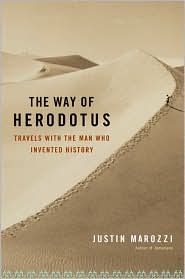 Justin Marozzi: The Way of Herodotus - Travels with the Man Who Invented History
Hardcover: 348 pages
Publisher: Da Capo Press 2008

Justin Marozzi: The Way of Herodotus - Travels with the Man Who Invented HistoryHardcover: 348 pages
Publisher: Da Capo Press 2008
Justin Marozzi approaches his subject by following Dionysius' first century BC quip "History is philosophy from examples". The Way of Herodotus is an easy-to-read political travelogue with lessons for tolerance and peace.
"Bush's vision of the course of history was different [to Edward Gibbon]. 'We meet here during a crucial period in the history of our nation, and of the civilized world,' he told an audience of 1,400 at the black-tie dinner hosted by the American Enterprise Institute in Washington on 26 February 2003. 'Part of history was written by others: the rest will be written by us.' ...
"Bush like Darius and Xerxes before him, like Nooteboom's Napoleon and every other wartime leader we can think of, dismissed all anti-war advice. He had his own trusted advisers who wanted war and they carried the day. Like the God of Genesis, they wanted to remake Iraq and the Middle East in their image. They wanted to break from the region's dictatorial past and forge a democratic future. They wanted to make history." p. 76-77
Second Opinion: Tobin Harshaw / The New York Times
¶ 3/17/2009 09:28:00 ip.
"Bush's vision of the course of history was different [to Edward Gibbon]. 'We meet here during a crucial period in the history of our nation, and of the civilized world,' he told an audience of 1,400 at the black-tie dinner hosted by the American Enterprise Institute in Washington on 26 February 2003. 'Part of history was written by others: the rest will be written by us.' ...
"Bush like Darius and Xerxes before him, like Nooteboom's Napoleon and every other wartime leader we can think of, dismissed all anti-war advice. He had his own trusted advisers who wanted war and they carried the day. Like the God of Genesis, they wanted to remake Iraq and the Middle East in their image. They wanted to break from the region's dictatorial past and forge a democratic future. They wanted to make history." p. 76-77
Second Opinion: Tobin Harshaw / The New York Times
3/08/2009
Sheehan: Transformation of Europe
 James J. Sheehan: Where Have All the Soldiers Gone? The Transformation of Modern Europe
Hardcover: 284 pages
Publisher: Houghton Mifflin Company 2008
James J. Sheehan: Where Have All the Soldiers Gone? The Transformation of Modern EuropeHardcover: 284 pages
Publisher: Houghton Mifflin Company 2008
I had to read this book before I redeem my promise to only read books with the phrase "...from 1500 to..." in the title and opt out of the IR scene altogether to pursue my real passion of fiction. Sheehan's text explains the victory of peace over war in Europe.
I argued in my thesis that K. J. Ståhlberg transcended (or at least believed in the possibility to transcend) war and narrow-minded power-politics-realism and found the end of history for a small liberal republic. Peace that enabled the creation of prosperity explains the success story of contemporary Finland. My account showed how the trick was done for, what was then, a peripheral small power playing against extremely unfavorable geopolitical odds.
James J. Sheehan, in his brilliant book, shows how the Great Powers did peace Europe-wide. I found some interesting similarities. Where I write, in the context of Finland's foreign policy, that the primacy of domestic policy goals over ambition in international affairs is the most potent source for success, Sheehan writes that: "During the long peace of the late nineteenth and early twentieth century we can find the historical roots of the civilian policies and institutions that would eventually dominate European public life. These policies and institutions were directed inward, toward domestic goals; they sought to encourage economic growth, promote commerce, and provide new kinds of services for their citizens." p. xviii
I argued in my thesis that K. J. Ståhlberg transcended (or at least believed in the possibility to transcend) war and narrow-minded power-politics-realism and found the end of history for a small liberal republic. Peace that enabled the creation of prosperity explains the success story of contemporary Finland. My account showed how the trick was done for, what was then, a peripheral small power playing against extremely unfavorable geopolitical odds.
James J. Sheehan, in his brilliant book, shows how the Great Powers did peace Europe-wide. I found some interesting similarities. Where I write, in the context of Finland's foreign policy, that the primacy of domestic policy goals over ambition in international affairs is the most potent source for success, Sheehan writes that: "During the long peace of the late nineteenth and early twentieth century we can find the historical roots of the civilian policies and institutions that would eventually dominate European public life. These policies and institutions were directed inward, toward domestic goals; they sought to encourage economic growth, promote commerce, and provide new kinds of services for their citizens." p. xviii
" 'Nations,' said General Spinola in the midst of the Portuguese revolution, 'prefer to live prosaically rather than disappear in glory.' " p. 187
Second Opinion: Geoffrey Wheatcroft / The New York Times
(A nice review! Wheatcroft calls the book "a scintillating tour d’horizon — and de force" and shows sofisticatedly the differences in foreign policy thinking in contemporary US and Europe. One can agree with his final sentence describing Europe's attraction to peaceful politics: "To put it another way, soccer is not only England’s and Europe’s gift to all mankind. It really is a better game."
¶ 3/08/2009 04:52:00 ap.
(A nice review! Wheatcroft calls the book "a scintillating tour d’horizon — and de force" and shows sofisticatedly the differences in foreign policy thinking in contemporary US and Europe. One can agree with his final sentence describing Europe's attraction to peaceful politics: "To put it another way, soccer is not only England’s and Europe’s gift to all mankind. It really is a better game."

