JM Book Blog
2/08/2009
Boot: War Made New
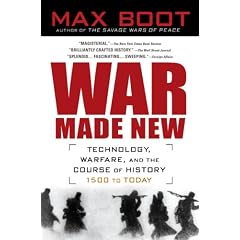 Max Boot: War Made New - Technology, Warfare and the Course of History - 1500 to Today

Max Boot: War Made New - Technology, Warfare and the Course of History - 1500 to TodayHardcover: 624 pages
Publisher: Gotham Books 2006
Max Boot's latest book is a solid historical account of technological changes in warfare with a grand and elegant title - anything with "...and the course of history from 1500 to today" sounds like a good book to me.
Boot has an intelligent way of writing and has a catchy habit of spicing up his grand historical sweep with juicy details. The reader learns seemingly trivial but entertaining facts: that Albrecht von Wallenstein (Waldstein) hated noise so much to order all dogs and cats killed upon his arrival in a town, that Helmuth von Moltke, "the Great Mute", spoke seven languages, wore an ill-fitting wig, had a horror of shaking hands and married a sixteen-year-old and that [Colonel J.F.C. "Boney"] "Fuller, who titled his autobiography Memoirs of an Unconventional Soldier, positively reveled in his reputation as a "heretic". Before the Great War, he had been a disciple of Alesteir Crowley, a cult leader who advocated drug use, sex rituals, Satanic worship, and the occult. Fuller even wrote a 327-page book expounding the principles of "Crowleanity"." p. 67, 123-124, 216.
"There were few more unlikely candidates in 1611 for Great Power states than Sweden. Even with its satrapy of Finland, the total population numbered no more than 1.3 million. They lived on the northern edge of Europe in an impoverished, barren, half-frozen country with almost no industry to speak of. So poor was Sweden that by winter's end peasants were often reduced to eating tree bark to survive. It was a society, writes historian Michael Roberts, "which was half-isolated, culturally retarded, and still in all essentials medieval." p. 61
"The U.S. has twelve aircraft carriers, nine of them Nimitz-class, nuclear-powered supercarriers that can carry more than seventy high-performance aircraft such as the F/A-18E Super Hornet. A tenth supercarrier is in the works. No one else has a single one." p. 421
Second Opinion: Josiah Bunting / The New York Times
¶ 2/08/2009 06:37:00 ap.
Publisher: Gotham Books 2006
Max Boot's latest book is a solid historical account of technological changes in warfare with a grand and elegant title - anything with "...and the course of history from 1500 to today" sounds like a good book to me.
Boot has an intelligent way of writing and has a catchy habit of spicing up his grand historical sweep with juicy details. The reader learns seemingly trivial but entertaining facts: that Albrecht von Wallenstein (Waldstein) hated noise so much to order all dogs and cats killed upon his arrival in a town, that Helmuth von Moltke, "the Great Mute", spoke seven languages, wore an ill-fitting wig, had a horror of shaking hands and married a sixteen-year-old and that [Colonel J.F.C. "Boney"] "Fuller, who titled his autobiography Memoirs of an Unconventional Soldier, positively reveled in his reputation as a "heretic". Before the Great War, he had been a disciple of Alesteir Crowley, a cult leader who advocated drug use, sex rituals, Satanic worship, and the occult. Fuller even wrote a 327-page book expounding the principles of "Crowleanity"." p. 67, 123-124, 216.
"There were few more unlikely candidates in 1611 for Great Power states than Sweden. Even with its satrapy of Finland, the total population numbered no more than 1.3 million. They lived on the northern edge of Europe in an impoverished, barren, half-frozen country with almost no industry to speak of. So poor was Sweden that by winter's end peasants were often reduced to eating tree bark to survive. It was a society, writes historian Michael Roberts, "which was half-isolated, culturally retarded, and still in all essentials medieval." p. 61
"The U.S. has twelve aircraft carriers, nine of them Nimitz-class, nuclear-powered supercarriers that can carry more than seventy high-performance aircraft such as the F/A-18E Super Hornet. A tenth supercarrier is in the works. No one else has a single one." p. 421
Second Opinion: Josiah Bunting / The New York Times
2/06/2009
Peace for Finland
My thesis studies Finnish foreign policy decision making between the years 1918 – 1920 in the context of the Allied and Associated Powers intervention to the Russian Civil War. The selected case study is analyzed through two theoretical frameworks: John Herz’s idealist – realist distinction of political thought and Randall L. Schweller’s balance-of-interest theory. The former is used to analyze the interplay of power and ideology in international politics; the latter to study statesmen perceptions of power and interests of state actors.
The selected research method is a case study operationalized as a theoretically informed historical narrative. The first part of the thesis presents the international context of the intervention with a focus on World War I, great power politics and Winston Chuchill’s anticommunism. The second part analyzes Finnish foreign policy decision making in detail. The narrative is centered on the first President of the Finnish Republic K. J. Ståhlberg and his non-interventionist reasoning. The counterfactual is provided by an analysis of the interventionist politics of C. G. E. Mannerheim. The concluding chapter presents an overview of Finland’s strategic choices and forwards a new narrative for Finnish foreign policy.
The question for Finnish foreign policy during the first years of the Republic was: war or peace for Finland? Under the leadership of Ståhlberg, Finland chose peace over war. Ståhlberg’s vision was based on his conviction that military forces should be defence forces. Ståhlberg – the father of the end of history for Finland – created a realist liberal foreign policy tradition that was anchored in a belief of liberal democracy as the best form of human government valuing internal evolutionist development over international ambition. Ståhlberg’s vision was powered by liberal optimism heralding that political freedom renders future wars unnecessary. This belief in transcendencing crude power politics eschews the cyclical tragedy of international politics.
Key words
Finland, foreign policy, K. J. Ståhlberg, liberalism, neoclassical realism, peace, war
Download War or Peace for Finland. (.pdf)
¶ 2/06/2009 06:55:00 ip.
The selected research method is a case study operationalized as a theoretically informed historical narrative. The first part of the thesis presents the international context of the intervention with a focus on World War I, great power politics and Winston Chuchill’s anticommunism. The second part analyzes Finnish foreign policy decision making in detail. The narrative is centered on the first President of the Finnish Republic K. J. Ståhlberg and his non-interventionist reasoning. The counterfactual is provided by an analysis of the interventionist politics of C. G. E. Mannerheim. The concluding chapter presents an overview of Finland’s strategic choices and forwards a new narrative for Finnish foreign policy.
The question for Finnish foreign policy during the first years of the Republic was: war or peace for Finland? Under the leadership of Ståhlberg, Finland chose peace over war. Ståhlberg’s vision was based on his conviction that military forces should be defence forces. Ståhlberg – the father of the end of history for Finland – created a realist liberal foreign policy tradition that was anchored in a belief of liberal democracy as the best form of human government valuing internal evolutionist development over international ambition. Ståhlberg’s vision was powered by liberal optimism heralding that political freedom renders future wars unnecessary. This belief in transcendencing crude power politics eschews the cyclical tragedy of international politics.
Key words
Finland, foreign policy, K. J. Ståhlberg, liberalism, neoclassical realism, peace, war
Download War or Peace for Finland. (.pdf)

